

 Facebook
 X
X
 Pinterest
 Copy Link
By Josh Vargas | Licensed California Realtor, DRE #02418970 | Coldwell Banker
Whether you are thinking about buying your first home, selling, or just trying to figure out what on earth is happening in the market right now, this post is for you.
The Short Version
Rates are coming down. Inventory is going up. Prices are holding steady but growing slower than they have in years. And for the first time in a long time, buyers have a little more breathing room.
It is not a buyer’s market yet. But it is no longer the “accept any terms or get left behind” seller’s market of 2021 either. We are somewhere in the middle, and that middle is where opportunity lives.
What Is Happening Nationally
Let’s start big and zoom in.
The map tells a clear story about where homes are selling fast and where they are sitting. The colors represent days on market, meaning how long it takes for a home to go from listed to sold. Blue is fast, red is slow.
The Midwest and Northeast are on fire. Nebraska is the hottest market in the country right now at just 71 days on market. The entire East Coast corridor is deep blue, meaning homes are moving fast. Meanwhile, states like Montana (129 days), Texas (114 days), and Louisiana (120 days) are red, meaning homes are sitting significantly longer before selling. Those markets got overbuilt or overpriced during the pandemic boom, and now buyers have pulled back.
California sits in the light blue range at 83 days, which means we are actually in better shape than much of the Sun Belt. Homes here are not sitting. Demand is real.
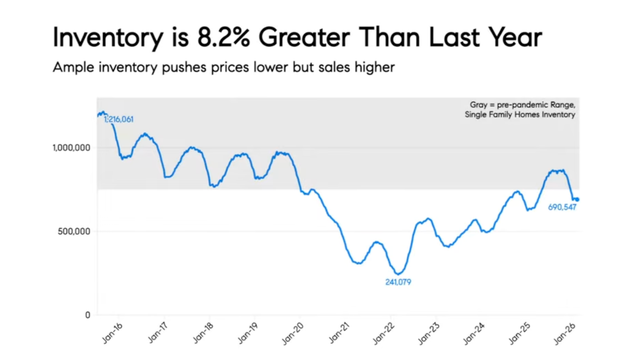
On the inventory side, the number of homes for sale nationally just hit 690,547 units, which is 8.2% more than this time last year. That is a meaningful improvement. More homes for sale means more choices for buyers and more competition among sellers, which keeps everyone honest on price.
The catch? We are still well below the pre-pandemic normal of around 800,000 to 1.2 million homes. So inventory is better, not abundant.

Placer County: Still a Seller’s Market, But More Balanced
Here is what the local numbers looked like heading into 2026:
- The average home sold for $777,000 in December 2025, up 2.8% from the year before
- Homes for sale were up 13.3% year-over-year, giving buyers more options
- 366 homes closed in December, up slightly from the same month last year
- Pending sales (homes under contract) were up 13% year-over-year, which tells us demand is still there
The bottom line: Placer County is still a seller’s market. There are simply not enough homes to meet demand. But the gap is closing, and sellers who overprice their homes are starting to feel it.
Well-priced homes in Roseville, Rocklin, Lincoln, and Granite Bay are still moving. Overpriced homes are sitting. That is a shift from even 18 months ago, when almost anything would sell regardless of price.
California: The Big Picture Numbers
The California Association of Realtors released its 2026 forecast, and here is what they expect:
- Median home price: Rising 3.6% to around $905,000 statewide
- Home sales: Up 2% from 2025
- Homes available for sale: Up about 10% from last year
- Mortgage rates: Expected to average around 6.0% to 6.3%, down from 6.72% a year ago
That drop in mortgage rates matters more than it might seem. When rates drop by even one full percentage point, it opens the door for roughly 5.5 million additional households nationwide to qualify for a home loan. Every fraction of a point makes a real difference in your monthly payment.
Why Are There Still So Few Homes for Sale?
This is the question I get the most, and the answer is simpler than you might think.
About 80% of California homeowners locked in mortgage rates below 5% over the last decade. The going rate for a new buyer today is around 6.2%. On a $900,000 home, that difference adds up to over $180,000 in extra payments over 30 years.
Most people are not willing to give up that low rate to move, even if they want to. So they stay put. Fewer sellers means fewer choices for buyers. Fewer choices keeps prices elevated. It is a cycle, and it only breaks when rates fall enough to make moving feel financially worth it again.
Rates are heading in the right direction. We are not there yet, but we are getting closer every quarter.
A Legal Shift That Could Actually Help Buyers
This one flies under the radar, but it matters for anyone watching housing costs.
In 2024, the U.S. Supreme Court ruled unanimously, 9 to 0, in a California case called Sheetz v. El Dorado County that local governments cannot charge excessive fees just to issue a building permit. In California, these fees average over $37,000 per new home built. Those costs get passed directly to the buyer in the purchase price.
Research cited in the case found that every $1,000 added to the cost of a new home pushes about 140,000 households out of the market nationwide.
The ruling now gives builders the legal footing to challenge fees that are out of proportion to what their project actually costs the community. If that leads to lower fees over time, new homes become cheaper to build and cheaper to buy. That is a slow-moving change, not an overnight fix, but the door is open in a way it never was before.
Note: I am not licensed to practice law and cannot provide legal advice. The above is general informational commentary only.
So What Does This All Mean for You?
If You Are Buying
This is the most favorable buying environment in several years, but you have to show up prepared.
Rates are still above 6%, which is not cheap. But they are falling, inventory is rising, and sellers are becoming more realistic. The conventional loan limit also increased to $832,750 this year, which means more buyers can put as little as 3% down in higher-cost markets.
The buyers who win this spring are not the ones who wait and react. They are the ones who get pre-approved now, know their number cold, and are ready to move when the right home shows up.
If You Are Selling
You are still in a solid position in Placer County, but the margin for error on pricing has shrunk.
By December, the average California home sold for about 97.9 cents on every asking dollar, and homes were sitting on the market for 36 days on average, up from 31 days a year ago. Neither of those numbers is bad, but they are signals. Buyers are pushing back on price in a way they were not before.
Price it right from day one. Homes that are positioned well are still selling quickly. Homes that are overpriced are bleeding days on market and ultimately selling for less than a correct initial price would have gotten.
If You Are Investing
Placer County’s proximity to Sacramento, strong employment base, and continued population growth make it a solid long-term market. Improving inventory and stronger legal protections for property owners following recent Supreme Court decisions add another layer of confidence for investors who know their numbers.
The Bottom Line
2026 is not a boom and it is not a crash. It is a market that rewards people who are informed and ready to move with purpose.
Rates are declining. Inventory is growing. Sellers need to be sharp. Buyers have more options than they have had in years. And the legal landscape is shifting in ways that could meaningfully lower the cost of housing over time.
If you have been thinking about making a move, now is the time to start having real conversations about what that looks like. The market is not going to wait for anyone to feel perfectly ready.
I am here to help you figure out your next step.
Josh Vargas is a licensed California Realtor with Coldwell Banker, DRE #02418970. Data sourced from the California Association of Realtors, National Association of Realtors, Compass and Placer County market reports. This post is for informational purposes only and does not constitute financial or legal advice.
